Application · Smart Grid

Smart Grid Applications

Solid-state transformers turn passive distribution infrastructure into an active, controllable grid asset — with voltage control, power quality and bidirectional flow built in.

Home/Applications/Smart Grid
The Challenge

Distribution Networks Were Built for One-Way Power

Distributed generation, EV charging and storage are pushing power through networks in directions they were never designed for. Utilities and grid operators feel it daily.

  • Voltage fluctuation: Solar and EV load swings push feeder voltages outside acceptable bands
  • Power quality: Harmonics, unbalance and flicker grow as power-electronics loads multiply
  • Bidirectional flow: Legacy transformers and protection schemes assume one-way power
  • Limited controllability: Passive transformers cannot regulate, filter or respond — only tap-change with coarse steps
  • Slow fault response: Conventional protection operates in tens to hundreds of milliseconds
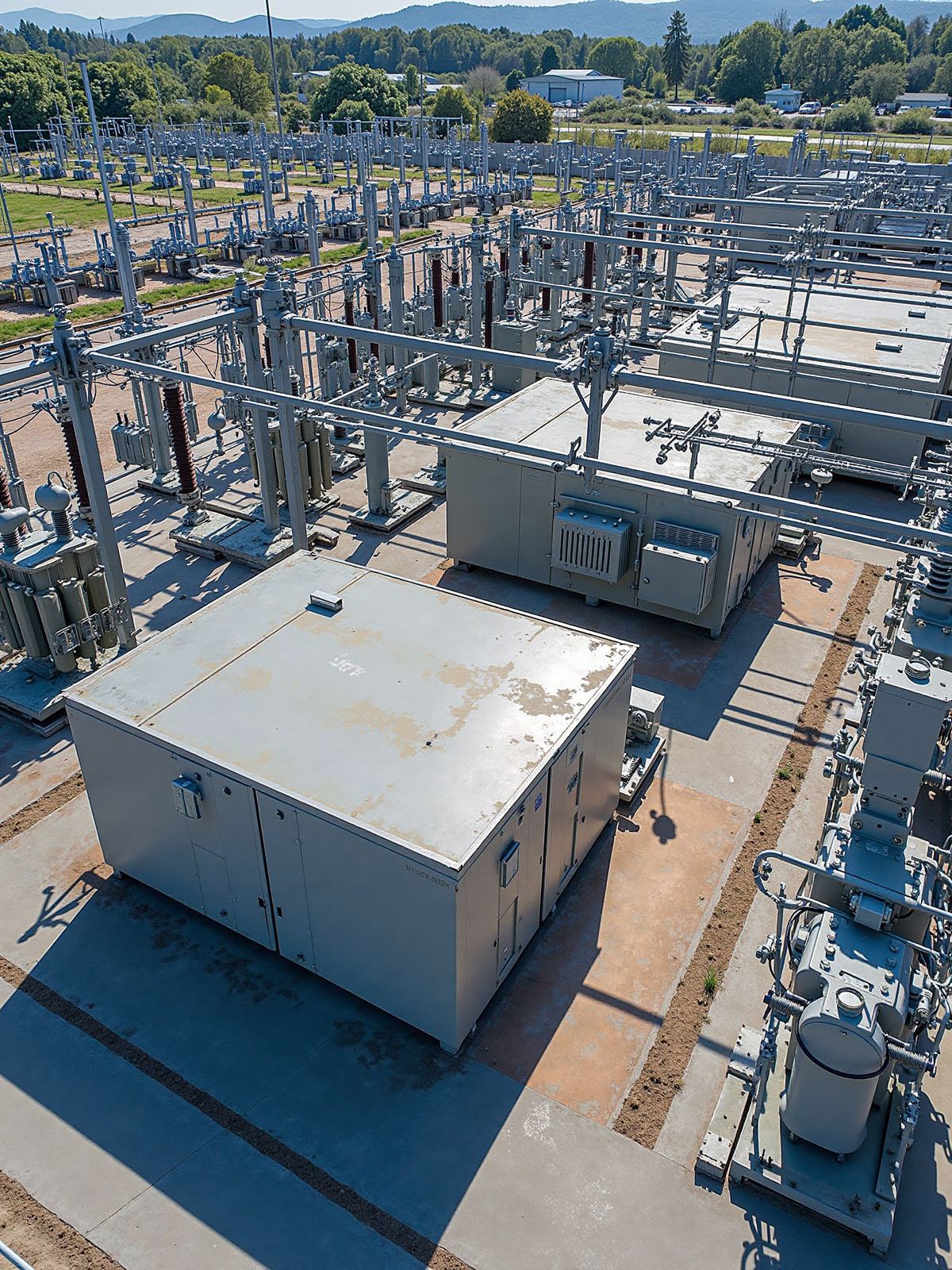
Smart Grid Modular Substation with SST
Our Solution

SST: An Active Grid Asset at Every Node

Unlike a passive transformer, an MV SST continuously measures and controls voltage, current and power flow — grid services become native functions.

Continuous Voltage Regulation

Millisecond-level voltage control replaces coarse tap changers — tighter bands, fewer complaints, better DER hosting capacity.

Bidirectional Power Flow

Handles distributed generation, V2G and storage discharge in both directions without protection redesign.

Power Quality as a Service

Harmonic filtering, reactive compensation and unbalance correction — replacing or reducing separate SVG/APF equipment.

Fast Fault Interruption

Semiconductor-based protection can clear faults in microseconds — limiting fault current and protecting downstream equipment.

IEC 61850 Native

Full substation communication and integration with SCADA, DMS and DERMS — an asset the control room can actually command.

Soft Open Points

SST-based soft open points (SOP) balance loading between feeders — recovering capacity without new lines.

Reference Capabilities

Grid-Scale Reference Specification

ParameterReference Range
Voltage Classes0.4 / 10 / 20 / 35 kV
Power Rating100 kVA – 10 MVA (project basis)
Control FunctionsVoltage regulation, reactive power, harmonic filtering, power-flow control, LVRT/HVRT
BidirectionalFull four-quadrant operation
Efficiency≥ 99% at full load
CommunicationIEC 61850, Modbus TCP/RTU, DNP3
StandardsIEC 60076, IEC 61850, IEEE 1547, IEC 61000 / IEEE 519

Complementary products: protection relays (SPH series), SVG / APF power quality equipment, DTU / SCADA and modular substations.

Implementation Path

From Feeder Problem to Pilot Node

1. Network Study

Load-flow, power-quality and protection studies identify where an SST delivers the most value.

2. Custom Design

Topology, ratings and control strategy engineered to the specific feeder and grid-code requirements.

3. Factory & Field Pilot

Type testing, FAT and a monitored field pilot with data collection before wider deployment.

4. Rollout & Support

Series deployment with full documentation, training and long-term engineering support.

FAQ

Common Questions

Do we need to replace all transformers to benefit?

No. SSTs are most valuable where the network has real problems — hosting-capacity limits, voltage violations, bidirectional flow or power quality. A soft open point or strategic feeder SST pilot addresses those points first, with targeted ROI.

How does an SST interact with existing protection schemes?

During the design phase we model the SST in the existing protection coordination. Its fast fault-clearing capability can actually simplify coordination by limiting fault current contribution, but every project is validated by a protection study.

Can it communicate with our existing SCADA/DERMS?

Yes — IEC 61850 and Modbus are standard, with DNP3 on request. The SST exposes measured values, status and control points so the control room treats it as a dispatchable asset.

Discuss Your Power Project

Tell us about your network, the problem you are solving and the grid code you must meet — our engineers will respond within 24 hours.

Discuss Your Power Project